Showing posts with label Doctor Who. Show all posts

Sunday, April 11, 2010

Small Beautiful Events

"For some people, small beautiful events is what life is all about!"

-The Fifth Doctor, 'Earthshock' (1982)


I tend to view Doctor Who in terms of the small, beautiful moments. I think it might be a hangover from my earliest days, because I've been aware of Doctor Who since long before my young brain was capable of processing actual narrative. Moments after my younger sister was born, my parents were so struck by her greyish, wrinkled/squashed appearance that they gave her the nickname "Davros" - as you might imagine, this rather stuck with me (and, I suspect, with her, although possibly in a slightly less happy way). My friends and I used to eagerly dissect the latest episodes on the way to and from primary school, but it was never the plots which got us truly excited - I seem to recall Ralph Bisset doing a pretty good approximation of Sylvester McCoy's histrionic "If we fight like animals, we die like animals!" the day after Part 3 of 'Survival' aired. The imagery and iconography of the show is imprinted on my brain at such a deep, all-encompassing level that my response to the revived series has frequently erred towards the Pavlovian – if it looks, sounds, and quacks like Doctor Who, then the odds are that I’ll be tickled pink by it, whether it’s actually any good or not. That the show has, for the overwhelming majority of the past five years, been both very Doctor Who and very good indeed, is somewhat remarkable.

I generally avoid clip shows - they tend to bore me, and rarely capture the essence of whatever it is they’re trying to represent. But I could, and occasionally do, watch compilations of moments from Doctor Who for hours on end. This montage,
from a 2007 episode of Doctor Who Confidential, genuinely brought a tear of joy to my eye the first time I saw it, and still fills me with a palpable sense of delight:


It's not that I can't appreciate some of the stronger plots with which Who has occasionally deigned to provide us - 'The Caves Of Androzani' is a masterpiece of tight, economical writing, and it's probably my favourite serial from the entire classic era. Steven Moffat's 'Empty Child' two-parter remains, I think, his finest work for the show, and it's still one of his most cleverly-plotted scripts. Even my favourite Russell T. Davies stories - and rightly or wrongly, he's not a writer known for his intricate, rigorously-constructed plots - tend to be the more tightly-plotted ones, like 'Smith & Jones', 'Gridlock', 'Midnight', or even 'The Christmas Invasion' (although I do retain a definite fondness for some of his less consciously-structured flights of pure, wild magic imagination). But if I had to settle on what really makes the show sing, for me, it all comes down to the moments.


So, it shouldn't really come as a surprise that I loved last night's 'The Beast Below' more-or-less unreservedly. Mild spoilers to follow, scroll down past the gerbil if you don't want to see them.


The plot, to be honest, was middling-at-best, and the societal structure and history of the Starship UK don't make a whole lot of sense if you really try to piece them together. Significant amounts of vital information were left completely un-filled-in (why was Britain the last country to leave? Why, since the other countries presumably managed just fine, were the Brits unable to put together a starship with an actual engine? What, exactly, were the Smilers for, and why were some of them half-human?). The escape-from-the-whale's mouth sequence, combined with the physiognomy of the creature itself as seen in the final shot, does rather beg the question of why the Doctor and Amy weren't just vomited directly into the void of space, and I'd love to know how they were able to dry their clothes so quickly for the subsequent scenes. But none of that matters at all, because so many of the moments we were given along the way were so wonderful, so note-perfect, and so essentially Doctor Who that I don't care for a second if the details of the backstory add up or not. Besides, the story of the episode wasn't really about the day-to-day details of the setting - that was just background colour, and it served the purpose admirably. The real meat was in the cataclysmic impact the Doctor's arrival has on that society, and that was delivered with delightful, and uncharacteristically-unrestrained, aplomb by new show-runner Steven Moffat.
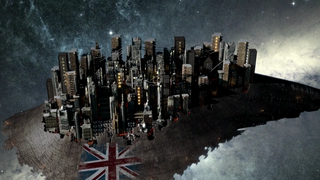

This was, as a lot of people are pointing out, probably the least Moffat-esque script that the man himself has written for the show since 2005. None of his usual timey-wimey paradoxes, relatively-little overtly-comic banter (which isn't to say that it wasn't funny), not a hint of romance, and at no point did an almost-but-not-quite human figure repeat anything even vaguely reminiscent of a catchphrase. In fact, the lurching-monster quotient was surprisingly-low, with the Smilers failing to make as much of an impact as their appearance in earlier trailers might have suggested. It did, however, really hammer home what I think is going to shape up to be the fundamental difference between Russell T. Davies' Who and Steven Moffats – for all the scares in ‘The Empty Child’, ‘Blink’ or ‘Silence In The Library’, his vision of the show is ultimately lighter, more optimistic, and without the nihilism which was often lurking just below the superficial frothiness of Davies' vision for the show.

Just think of the Toclafane, from 'The Sound Of Drums’/’Last Of The Time Lords' - the inevitable future of mankind, to degenerate into a callously-homogenised army of hideously-mutated Steel Balls of Death, who kill, slaughter and maim their own ancestors for the sheer glee of it. And for all the sometimes-justified criticism of Davies’ reset-button endings, that one’s never fixed – that’s now the official Whoniverse End Of Humanity. Never mind shadow-piranhas or creepy statues which jump out and say "Boo" - that's how you do "dark" in a Doctor Who story. In the finest spirit of post-apocalyptic horror being served up to a post-football Saturday evening audience, it's one of the most shockingly-bleak ideas in the show's entire history. Nothing Moffat has ever done is that genuinely dark, and I seriously doubt that it ever will be. His mind simply doesn't work that way. His stories tend to be a lot more complicated than Russell’s, but at the same time, they’re arguably less complex, at least emotionally.

They're also, generally, a lot less freewheeling, more tightly-controlled and elaborately-structured. Which is why ‘The Beast Below’ came as such a delightful surprise (it’s also, I suspect, why it seems to have been a bit of a ‘Marmite’ story within Who fandom at large). Instead of exhaustively wrapping every idea, every loose plot strand up into a neat, intricate package, this was a sprawling mess of a script, packed with more ideas than it really had space to properly explore, and it was all the better for it. Watching the accompanying episode of Doctor Who Confidential, I was delighted to see that Moffat’s explanation for the half-human/half-Smiler creatures amounted, essentially, to “I just thought it was a cool idea”. It didn’t turn out to be intrinsic to the episode’s plot, as has been the case for most of the apparently-incongruous elements of his previous stories. He wanted a cool monster, so he stuck it in there, and trusted his audience to simply accept it because it felt right. That’s pure Doctor Who, and now that Moffat’s shown that he’s willing and able to let his imagination run unfettered when it seems appropriate, I think I’m finally ready to relax, and just enjoy his era on its own merits.

Speaking of merits…Matt Smith IS the Doctor. Brilliantly-so. If I had any reservations after ‘The Eleventh Hour’, it was that a lot of his dialogue, and a few mannerisms, were heavily-reminiscent of David Tennant’s Tenth Doctor – this episode absolutely blew those concerns away. While the character retains that innate essence of Doctor-ness which has been in place for well over forty years, Smith is bringing a lot to the part which is fresh and new. Simultaneously, though, he's cherry-picking elements of older Doctors, particularly Patrick Troughton, which weren’t really present with either Eccleston or Tennant. His freewheeling, unforced eccentricity is infectious, but there’s a lot more to him than just wackiness or mania – there’s an analytical, professorial air which is in sharp contrast to his immediate predecessor.


Very astutely, given Smith’s relative youth, both this episode and ‘The Eleventh Hour’ have included prominent scenes where he gets to interact with children – not only does he have a charming, easy-going chemistry with the young actors, but by placing him in that context, we get to see him from their perspective – not quite an authority figure, perhaps, but still as someone Old, who radiates wisdom and kindness in equal measure. That instinctively colours our impression of the character - it’s a very clever touch on Moffat’s part, and it’s worked magnificently.

Karen Gillan, as new companion Amy Pond, is similarly-excellent – she was split up from the Doctor for quite a bit of this story, which gave Gillan a welcome opportunity to show how the character fares alone. Happily, she more than holds her own. I’m trying hard to steer clear of the adjective “feisty” – not only does it seem to come as standard for all red-headed actresses, but it’s also been applied to every female Doctor Who companion since the ‘60s, and has become terribly-stale as a result. She blatantly is, though, which makes it rather hard to avoid. Independent, intelligent but clearly troubled – partly as a direct consequence of the Doctor’s appearances throughout her life, which gives an interesting twist to their relationship – it’s clear that there are still depths to her character which we’ve barely seen hinted at, and much of the meta-narrative of this season is presumably going to be devoted to the Doctor’s attempts to draw them out. Shades of the Seventh Doctor and Ace, perhaps, but hopefully rather better-written. That should fit well with the Troughton-isms in Smith’s performance.


The story was, like ‘The Eleventh Hour’, distinctly-reminiscent of a number of previous episodes – but where that one drew heavily from Moffat’s own back catalogue, this was a far more haphazard blend of elements from what I like to think of as RTD’s “mad future” stories – ‘The End Of The World’, ‘Gridlock’, and even ‘The Long Game’ were brought to mind, although it remained still very much its own entity. It reached further back, too – most notably to Tom Baker’s ‘The Ark In Space’, whose 29th Century exodus from Earth was directly referenced. There was also a sizeable chunk of Sylvester McCoy in there, with the Doctor effortlessly bringing down a whole corrupt society in a few short hours, just as he did in ‘Paradise Towers’, ‘The Happiness Patrol’, and so many of the Virgin New Adventures novels.

This Doctor may be good with kids and quick to crack a joke (the “escaped fish” gag was inspired), but there’s a steeliness, an unwillingness to compromise, behind that youthful façade, and it’s intriguingly-different from his predecessor’s “no second chances” persona. Quieter, less bombastic, but more intense and possibly more frightening – the moment in the torture chamber/pilot room, where he coldly dismissed Amy without a second thought, was genuinely chilling. We haven’t seen that side of the Doctor since Eccleston unceremoniously dumped hapless would-be companion Adam back on Earth, and that cold brusqueness was even more un-nerving here, directed at a character who we actually like. It’s good that the new Doctor is likeable, but it’s even better that we can’t always be entirely comfortable with him, either.


OK, here’s the gerbil.

Photobucket


I’m trying hard not to get too carried away, but if the show maintains this sort of standard, then not only are we in for a very strong season, but Matt Smith may just shape up into one of my favourite Doctors ever. So far, so very good indeed.


Monday, April 5, 2010

BLOG POST DELAYED DUE TO ILLNESS: AUDIENCE SHOCKED, BEWILDERED

I was due to post a new 30 Days Of Music piece this evening, but I'm ill, so I'll be going to bed instead. So the Doctor Who review below is your lot for today, I'm afraid. Normal service will be resumed tomorrow.

In lieu of "a song which sends me to sleep", have a rather nice montage from Who's 40th Anniversary, back in 2003, set to an abbreviated remix of Orbital's version of the theme tune, as mentioned in my previous post. If Doctor Who had been on the air during the '90s (we do not speak about the McGann Incident, OK?), I'd like to think that this is what the music would have sounded like.


Leadworth Cutaway

So, my favourite TV show in the world returned on Saturday, for its thirty-first season, the fifth since the 2005 revival, and the first under new producer/showrunner Steven Moffat. Review follows.

WARNING: Spoilers will, obviously, abound, and footnotes for the uninitiated will not. So don't bother reading this unless you (a) watch Doctor Who, and (b) have already seen 'The Eleventh Hour'.

I haven't figured out how to code a proper "read further behind the cut" blog post, so for the time being, a good old-fashioned stretch of Spoiler Space will have to do. Scroll down to the picture of a gerbil if you don't want to be spoiled, everything after that should be safe.
.
.
.
.
.
.
.
.
.
.
.
.
There, that should be just about enough.

I'll start with the negatives, just to get them out of the way. First and foremost - quite literally, since aside from a brief TARDIS-crashing-to-Earth opening sequence, it's the first thing we actually see - the new title sequence is seriously weak. Not the visuals - while not quite as dramatic and fast-moving as the previous, slightly nausea-inducing version, they're pretty straightforward - but the new arrangement of the theme tune. To be fair, I'd cheerfully concede that I'm nearly impossible to please on this particular score (no pun intended), since I'd rate the original, 1963 arrangement of the theme produced by Radiophonic legend Delia Derbyshire as one of my favourite pieces of music ever, and all subsequent reworkings as manifestly-inferior demonstrations of the law of diminishing returns. Short of restoring the Derbyshire original in its full glory, or switching to the splendid version produced by UK dance titans Orbital back in the '90s, there's virtually nothing the production team could do to wholly satisfy me with the theme music, so any criticisms I have to offer should be taken with a fairly hefty pinch of salt. But compared with the dynamic, orchestral take on the theme which we've been given for the past few years, this new one seemed mushy and lacking impact - the opening beat going on for just a few seconds too long, and the first howl of the melody - "ooooEEEEEEEOOOOOHHHH..." oddly-buried behind an inappropriately-straightforward, martial drum beat. It's the same mistake made in the marching-band arrangement used for the 1996 TV movie, and consequently, it fails to move me in much the same way. Ho, and indeed, hum.

To be honest, that's about it so far as unequivocal criticism goes. The spitting-out-food sequence near the beginning went on a lot longer than I'd have liked - the joke wore thin fairly quickly, although Matt Smith delivered it well enough - and at 65 minutes, the episode felt oddly-paced. It wasn't exactly padded or slow, but compared with previous season-openers, there didn't seem to be enough plot to really warrant the extra twenty minutes, particularly as the time wasn't spent giving extra depth or breathing-room to the main narrative, which felt slightly-rushed as it approached the conclusion. The slightly more relaxed pace of the opening sequence was welcome, though, and to Moffat's credit, "The Eleventh Hour" is a perfectly-good, if obvious, pun.

Indeed, the plot itself was surprisingly-thin, although not in a particularly dissatisfying way. There were at least a few contrivances, hand-waves and plot holes (why were the coma patients calling for the Doctor, anyway?) which would have been fiercely pounced-upon by many of the people raving about this episode had they cropped up in a Davies script, but that's hardly the end of the world. Given a new Doctor and a new companion to introduce, Moffat sensibly stuck to a comfortably-familiar scenario, which was probably the best way of easing younger viewers into the new era.

The B-plot was heavily-reminiscent of 2007's 'Smith & Jones', still for my money the best season-opener the revived show has produced (alien convict hides out in a hospital disguised in human form, clodhopping Space Police show up to catch him/her with little regard for collateral damage, leaving the Doctor to both capture the prisoner and protect the human bystanders from inadvertent destruction), with several key bits of structural trickery and plot elements lifted directly from Moffat's earlier episodes. After 2008's slightly-disappointing 'Silence In The Library' two-parter, in which Moffat also recycled several of his earlier plot ideas to slightly-diminished effect, this could be a slight cause for concern, but I won't be worrying about it unless the same tropes are brought out again later in the season. Something to keep an eye out for, perhaps, but certainly not a problem - besides, the 'Girl In The Fireplace' set-up is an effective one, so there's no real reason not to use it again, given a slight spin, from time to time. Repetition certainly never did the old "base under siege" formula any serious harm.

I do, however, think that some of the praise the plotting has received is more than a little over-the-top - it really wasn't significantly tighter than most of Davies taut, economical season openers. It was, I felt, unequivocally-superior to 2006's 'New Earth', and more effective as a story than 'Rose', but then again, it had rather less to do than that one did. The tone was different, but the plotting here was certainly no more sophisticated, complex or coherent than that of 'Smith & Jones' or 'Partners in Crime', even with an extra twenty minutes to play with. Given Moffat's knack for a well-turned narrative structure, though, I'm looking forward to seeing what he does with this year's season-long arc and doubtless epic finale - there were plenty of hints dropped here, but it's still far too early to have any clear idea of the plan.

But the B-plot, as in Davies' opening episodes, was almost irrelevant compared with the far more important story, which was the introduction of a new Doctor and a new companion. Matt Smith's introduction was, perhaps, the least troubled regeneration since the concept was first introduced - there was still a slight sense of a new personality bedding itself in (I enjoyed the subtle ways in which his performance became less and less Tennant-esque as the episode progressed), but it wasn't central to the story in the way it typically has been in the past. It's still too early to really make any firm judgements on the Eleventh Doctor's character, but Smith absolutely owned the role from his first moments onscreen, with an unforced eccentricity and easy-going authoritativeness when required. I look forward to seeing how his performance will develop over the next thirteen weeks. I was less fond of the occasional hints of preening braggadocio - the "I'm the Doctor, google me" approach to threat resolution grated on me in 'Forest Of The Dead', and I didn't like it any more here. That seems to be part and parcel of the modern show, though, and provided it doesn't get drawn out too often - and provided it's balanced, as it was here, with plenty of Doctorly smartness, resourcefulness and wit - it's something I'm happy to live with. It seems to have gone down well with the show's core audience of young and casual viewers, too, which is far more important than my more fannish nitpicks.

Amy Pond was, perhaps, a little less clearly-developed - we got a strong impression of her character type, but the finer details of her personality were rather more thinly-sketched. We'll doubtless be getting to know her better over the course of the next however-many weeks, though, and there was plenty of potential in Gillan's performance. The lengthy preamble with Young Amelia (exceptionally well-played by Karen Gillan's cousin) set up the basics of her character nicely, and we'll get to see how those early experiences have really shaped her adult personality as the series progresses. Could have done without the kissogram thing, but that's Steven Moffat for you, and Amy was generally a strong enough character that it didn't initially strike me as too problematic.

Speaking of Moffat, while his plotting may not have been quite as elaborate as usual, he still excels at snappy, quotable dialogue - far too many great lines to mention, although I was particularly taken with "I'm the Doctor - I'm worse than everybody's aunt!" The handful of lines and images reprised from earlier episodes, like easter eggs for the attentive viewer, were also appreciated, and reinforced my impression that the familiar structure was a conscious choice, rather than laziness or self-plagiarism.

Right, gerbil time:


I could have gone on for a lot longer, but this post is already over-long, and I'm beginning to ramble. Overall, then, an extremely promising start to a new era. Nothing too revolutionary - and wisely-so - but an assured, confident debut for the new producer and star. Most importantly, it made me eager for the next episode, which is all you could reasonably ask for in a season-opener.

Again, again.

Sunday, July 1, 2007

"Was that it?"

Note: The post below was originally made for the first, abortive incarnation of this blog, which spluttered to a halt almost immediately when I realized that I wasn't actually all that interested in writing a blog at all. Time will tell if that's changed this time around, but in the meantime, while I've deleted the other remnants of Blogge The Firste for reasons of irrelevance and dullness, I'm leaving this post intact, largely because I find it mildly interesting to have a time capsule record of my own reaction to the episode in question fresh from the initial viewing. Particularly interesting, to me if nobody else, are the areas where it differs from my current, hindsight-assisted take on the same story.


So, Season 3 (or, if you’re a pernickety nerd like wot I am, Season 29) of Doctor Who concluded last night, in a manner that was, if nothing else, spectacular. I’m actually planning to write a general overview of the whole season at some point in the next few days, but for the sake of actually getting some actual content up on this blog, I’m going to give my - somewhat garbled - initial impressions of the finale here. The following is based loosely around the notes I made on the second viewing of the episode, earlier this morning, and as such, may not be entirely coherent. I would apologise for this, but since it seems eminently appropriate to the episode in question, I’m not going to.

Oh, and a (fairly obvious) warning – the following will not only reveal substantial quantities of the plot to 'Last Of The Time Lords', but will probably make very little sense to anyone who hasn’t seen it.

ROLL OPENING CREDITS.

- Possibly the greatest single problem with the episode becomes apparent with the opening scene. I was suspecting this would happen after last week's cliffhanger, but from the moment this episode began, it was obvious to anyone with a brain that it was going to end with the whole time-line being reversed somehow. Large-scale alien invasions are one thing, but having the Earth as a ravaged post-apocalyptic wasteland simply isn't a viable new status quo for the type of show Doctor Who has always been, so it was inevitable that they weren't going to stick with it. Being aware of that, it was very difficult to make any emotional connection with what happened from that point on - every new horror was simply another thing which I knew was going to be undone, so why care?

- Martha was able to visit just about everywhere on Earth in a single year? On foot (apart from the bit when she single-handedly sailed the Atlantic)? Really?

- She’s still wearing her magic key o'invisibility, which shields her from the Toclafane scanners, but she tells the resistance guy that he can see her "because he wants to". Umm...so what about that scene last week when the Doctor demonstrated how the key worked by putting it on? Did Martha not want to see the Doctor, or something?

- Right. Everyone who didn't see where the "Battered Wife" storyline was heading from the very second Lucy Saxon slumped onto the screen with shoulders bowed and face bruised, would you please raise your hands?

OK, anyone with their hand up is a fucking moron. Not only is it numbingly predictable, but the way "she's a victim of domestic abuse!" was used as an all-purpose substitute for any kind of fleshed-out characterisation is extraordinarily lazy writing, bordering on the genuinely offensive. It’s also a shameful waste of a character who, when she first appeared last week, seemed rich with potential.

- The dismal, doomed-to-failure escape attempt by the captives onboard the SHIELD helicarrier was actually rather effective. But when did the previously-human (albeit-immortal) Captain Jack develop super-strength? He pulled a set of metal chains out of the wall with his bare hands, an action which my knowledge of physical reality informs me would, in fact, simply result in a pair of dislocated shoulders, and two resolutely un-pulled-out chains. Yes, the show is sci-fi/fantasy, but that doesn’t mean it shouldn’t strive for an internally-consistent reality. The sudden manifestation of superhuman strength by a character who’s shown no previous tendencies towards it is the sort of thing which really should be commented upon within the plot – or, preferably, avoided altogether.

- Speaking of Martha's family (which I was for a moment there), where the hell was her brother? What exactly was the point of his "escape" last week? Very slapdash plotting, and one of a number of plot strands which were established in previous weeks, only to go nowhere here.

- The computer-generated Gollum/Yoda version of the Doctor looked rather good, as a special effect (the cutesy, big-eyed design struck me as a mistake, mind). However, and this is important, it was still a rather good-looking ONE-FOOT TALL GOLLUM-DOCTOR, and if I have to explain why that's retarded, you're simply never going to see this in the same way as I do. Suffice to say that it takes the character rather further from reality than I’m comfortable with – yes, he’s alien, and at times he should seem very much so in characterisation terms, but the physical nature of his body has always remained essentially human-looking, for good reason.

- OK, so now it seems that the drumming which was introduced last episode is something that the Master's been hearing all his life, which has simply never been mentioned before. That's a big ol' retcon, that is – which would be fair enough (although still a very awkward fit for anyone who's actually seen the earlier Master stories, in which he never seemed particularly distracted by imaginary noises), if not for the fact that the way the drumming was introduced last week made it seem specifically relevant and significant to the current storyline. It’s a basic writing error – plot elements, once established, need to be resolved one way or another – and one to which Russell T. Davies seems unusually prone.

- "I'm going to kill the Master". "No, I'm going to kill the Master." "No, I'M going to kill the Master." Ferfooxache. At least when the exact same scene occurred in the Simpsons episode 'Who Shot Mr. Burns?' it wasn't meant to be taken seriously. Clumsy, unconvincing and heavy-handed.

- So, the Doctor knew that the Master would be planning a big global countdown at which point everyone who believed in fairies could clap their hands, did he? And, what's more, he knew that this countdown would be broadcast worldwide, to the entire population of Earth? Even the ones without access to (non-functioning, apparently) televisions? And he was able to convey this to Martha with approximately 3 seconds of whispering?

- Come to think of it, what were the Little Population-Subjugating Silver Balls Of Death doing when everyone was gathering in big, suspicious crowds all over the world?

- Ah, the Power Of Love resolution, as seen before in such masterpieces as last year’s 'Fear Her', and all of the really crap episodes of Buffy (and, in the one documented instance of this particular plot device being used well, in the final issue of Grant Morrison’s JLA run). But really, what the fuck? I can't even begin to get my head around how this was supposed to work. Leaving the basic implausibility of the conceit aside (tricky, but give it a go), how exactly did a global telepathic field of Belief In The Doctor disintegrate his cage, or provide clothes for the newly re-embiggened Doctor? Did the tiny suit the Master had, presumably, made for his tiny pet simply stretch?

- And now, a melodramatic cliff-top confrontation! For no reason!

- OK, so the time-reversal was pretty much inevitable, as I mentioned earlier. But why did everything revert back to that specific moment? If the Toclafane are trapped at the end of the Universe, and the whole thing never happened, how did the President die? Lame.

- The direction was very weak throughout, with several key sequences feeling flat and lifeless, visually-speaking. The accelerated-aging effect for the Doctor, in particular, was laughable.

- What the hell was up with all those flashbacks? The whole episode was littered with them, to a genuinely-intrusive degree. Was it just lack of confidence in the audience on Davies' part, or was he so stung by the criticisms of the Bad Wolf/Torchwood non-arcs in the previous seasons that he decided to go all-out to prove that no, really, this time IT’S ALL CONNECTED?

- Speaking of genuinely-intrusive, wasn’t Murray Gold’s cloying, overwhelming score annoying? He’s done rather better this year than in previous seasons – the absence of tinny-sounding synth drumlines was appreciated – but all the flaws in his work were present here. Also, the sound mix was appalling – to hear the dialogue clearly, it was necessary to turn the volume up so high that the music was deafening. This has been a problem all season, but was particularly glaring this week.

- Couldn't Davies have come up with a slightly better structure to the episode than "keep everyone in the dark for half an hour, then fill in everything in one big, tedious chunk of clumsy exposition"?

- The whole episode was so shamelessly derivative that it's hard to get worked-up about the Funeral For A Jedi moment at the end, or with Ming The Merciless picking up the ring. But still...there you go.

- Given the fact that they'd already committed to an unrequited-love character arc months ago, Martha's farewell to the Doctor was about as good as it could have been - and at least she came to that conclusion on her own. Still, it begs some serious questions about the wisdom of her entire character arc over the course of the season. The constant, forced comparisons with her predecessor were desperately annoying, not least because they served to highlight the degree to which Martha actually was a better person than Rose. I'm not saying she was a better character, either in conception or execution (I think she was, personally, but that's not the issue), but her final scene, in which she – quite rightly - stays behind for the sake of her family, is a direct contrast to a similar situation at the end of Season 2, when Rose made precisely the opposite decision. What was that about? Were we supposed to realise that actually, Rose was a bit of a cow, making the Doctor even more of a dick for treating Martha as second-best all season? I doubt it, but that's the impression I was left with.

That aside, though, the idea that we needed a whole season, an entire character's 13-episode journey, to finally show the Doctor getting over Rose (which this week's Doctor Who Confidential explicitly states was the intention behind Martha's character) is fucking ridiculous. What, exactly, was 'The Runaway Bride' for, then? Unlike a lot of old-school fans, I'm not fundamentally opposed to the introduction of a romantic aspect to the show - I thought that last year's 'The Girl In The Fireplace' was one of the best Doctor Who stories ever, for example, in a way which simply wouldn't have been possible in the pre-Davies era - but I find RTD's continued self-congratulatory insistence that Rose was the ideal companion/love of the Doctor's life deeply embarrassing. It wasn't really an issue in Season 1 (whatever the writers intended, the onscreen chemistry between Piper and Eccleston simply didn't suggest a romantic relationship to me), and the sudden change in the central character dynamic was a large part of the reason I found much of Season 2 disappointing. The fact that we are still being smashed over the head with it a full year later is downright absurd. Having the Master - who not only never met Rose, but has no reason to even know she existed - make a direct reference to her, instead of to one of the many companions he's actually met and been defeated by, was simply the icing on a particularly stale cake.


There were, of course, some things I liked. The reveal of the Toclafane's true identity was a good one, although not something we haven't seen before elsewhere (most recently in Grant Morrison's excellent Seven Soldiers series in fact - it wouldn't surprise me if that's where Davies got the idea from, since he's not shy about being something of a comics fan). That's not really a problem, though, and neither is the fact that I figured the twist out a good few days ago - it was pretty much the only explanation which made sense. At least it resolved my major criticism of The Sound Of Drums, which was that it rendered most of Utopia utterly pointless.

John Simm was an absolute delight from start to finish as the Master, with his opening song-and-dance routine to the Scissor Sisters’ 'I Can't Decide' ranking as a particular highlight of scenery-chewing arch-villaindom. Unfortunately, his gleefully over-the-top performance served largely to highlight the desperately po-faced self-importance of the rest of the episode. One gets the feeling that Davies was deliberately setting out to write a Big, Important, Epic Story, and had a list of items to check off in order to achieve this. Sadly, Big, Important and Epic aren't enough on their own, and he somehow failed to check the box marked “coherent plot”.


All of that said, I'm still cautiously optimistic about Davies' continuation as producer for at least another year. After all, the lameness of the conclusion doesn't diminish how good the rest of this season has been, particularly in terms of coherent tone and direction – a massive improvement on the meandering, unfocused second season, and something which is due largely to Davies’ work as show-runner.

More importantly, the bits and pieces of this story that appear to be setting the scene for the next season are, in themselves, quite promising. It seems that the Doctor has, finally, removed the Rose-shaped chip from his shoulder, and Martha's not-quite-a-total-departure leaves me hopeful that we'll be seeing something a bit different in regard to the setting and overall structure of the next season. With Martha's Emergency Phone to provide a handy reason for the Doctor to visit contemporary Britain (and Captain Jack in place to make guest appearances if/when he does), they've got the space to try something a bit different in terms of companions, alien worlds, and season-long arcs. Whether or not they’re going to take advantage of that is uncertain, but I'll be interested to see where it goes from here.