My favourite album isn't really an album at all. Not the version of it I like, anyway. There was a double-album release in the mid-'70s, calling itself The Basement Tapes and containing at least some of the performances which make up the original set of Basement recordings, but it's a bastardised, second-rate imitation of the real thing, capturing very little of its ramshackle glory. Sure, some of the most notable compositions Dylan wrote during those pivotal few months in Woodstock are present, but too many others are bafflingly-absent, and the eight Band originals included, recorded separately and with no involvement from Dylan, are completely superfluous at best, distracting at worst.
Most damningly, by focusing solely on the more 'completed'-sounding material (and adding after-the-fact overdubs to clean much of it up for official release), it completely fails to capture the essence of those otherworldly tapes, that slapdash looseness, the jokey covers, the thrown-away jams, the half-formed skeletons of songs which would never be completed. The true worth of the Basement Tapes is far, far stronger than the sum of its frequently half-baked contents. Taken as a whole, these fragments of music take on a stronger life of their own, evoking what Greil Marcus so memorably termed "the old, weird America" in a mysterious voice which no other album I've ever heard has quite managed to replicate.
* * * * * * * * *
I should probably backtrack a little here, just to explain something of what I'm actually talking about for the benefit of any unfortunate souls who've never encountered The Basement Tapes.
By 1967, after spending most of the past five years turning the world of popular music on its head and becoming one of the most famous men in the world, Bob Dylan was in desperate need of an escape. Seizing the opportunity presented by a (relatively-minor) motorcycle crash in 1966, he cancelled all forthcoming concert dates, and disappeared from the public eye entirely for a prolonged period. During his time off, Dylan spent a lot of time just hanging out with various musicians, mostly the members of his former touring companions The Band, in an isolated house in upstate New York (the house was, and remains, known as Big Pink - the bulk of The Band's debut album, Music From Big Pink, was recorded during this period).
They drank a lot, smoked a lot of pot, and most importantly, they played a lot of music - most of it comprising songs written on the spot, covers of standards both old and new, instrumental jams, drunken joke songs, and the like. Some of these performances were recorded, using whatever equipment happened to be on-hand, and it's these widely-bootlegged recordings which make up The Basement Tapes.
Dylan's absence from the public eye corresponded fairly directly to the height of the psychedelic movement, and - not by coincidence - his return to the public eye corresponds even more directly with its end. Indeed, it wouldn't be too much of an exaggeration to suggest that he was, to some extent, responsible for the dramatic shift back towards rootsy, folk-and-blues-infused music which began to take hold in late 1968. He was, and remains, openly dismissive of the more indulgent excesses of the psychedelic era, and the often-archaic material recorded at Big Pink constitutes a very conscious, deliberate counterpoint to that excess (many of the songs covered are literally centuries old, and even the Dylan/Band originals hark back very deliberately to the styles and forms of traditional folksong).
A sampler of notable songs extracted from the Big Pink sessions was circulating in music-industry circles by the early summer of '68, and copies ended up in the hands of, among others, George Harrison and Eric Clapton - both of whom duly played them to their respective bandmates and other musical friends.
All of the Beatles have acknowledged that the tape was a massive influence on their change in direction between the psychedelic pomp of Sgt. Pepper and the back-to-basics nature of much of the White Album - and where the Beatles went, the world followed. Clapton's dissolution of Cream and subsequent move back to more traditional material. The Stones' 'Jumpin' Jack Flash', and the subsequent classic folk/country/blues triptych of Beggars Banquet, Let It Bleed and Sticky Fingers. Clapton's dissolution of Cream, Hendrix's post-Electric Ladyland change in direction. All seismic cultural landmarks, hugely-significant to the development of rock/pop for much of the next decade, and all directly traceable to the twin influences of Music From Big Pink and The Basement Tapes.
But of course, there's far more to the Tapes than dry academic interest or historical significance. First and foremost, they're an astonishing, unique collection of music - richly-varied, atmospheric, strange, and spontaneous. It's the sort of ad-hoc, rough-hewn primitivism which would, in the hands of most musicians, be barely-listenable, but thanks to Dylan's genius and the peerless chemistry he shared with Robbie Robertson, Richard Manuel, Rick Danko and Garth Hudson, they become something uniquely-special. They are, without a doubt, my favourite collection of music ever recorded by any group of musicians, and the fact that so much of this remain unreleased is truly baffling, particularly in light of the otherwise-splendid work done by the compilers of Dylan outtakes/rarities for the justly-lauded Bootleg Series.
Even before the release of 1975's bastardised, half-hearted official version, numerous Basement songs had been released in one form or another, either as covers or recorded by the Band themselves. 'Tears of Rage', 'Quinn the Eskimo', 'You Ain't Goin' Nowhere', 'This Wheel's On Fire', 'Crash on the Levee (Down in the Flood)', 'I Shall Be Released' - all among Dylan's finest songs, and all originally recorded in the Basement. But plenty of significant recordings remain the sole preserve of bootleggers, and the sort of fanatical fans who eagerly seek them out (*ahem*). Chief among these was, until recently, the song I was hoping to choose today - 'I'm Not There', which finally saw the light of an official release two years ago, on the soundtrack to Todd Haynes' splendid film of the same name. Unfortunately, there doesn't appear to be a copy of the Dylan version of the song on youtube right now, although anyone who's particularly keen to hear it might consider checking out Sonic Youth's excellent cover version, recorded for the same soundtrack.
It's a half-finished song, with ambiguous, ad-libbed lyrics and a meandering, dreamy melody played with delicate looseness by the Band. Sonic Youth's version, while inevitably cleaned-up slightly for the studio, captures more of the original's evocative magic than I'd ever have imagined possible, but still, inevitably, falls short of its slapdash perfection. I'm actually quite glad that Dylan never went back to finish this song, as he did with a few of the other pieces recorded during the same period, because I can't imagine any polished, properly-completed version of the song quite living up to the sketch which survives.
In the absence of that song, then, I've cheated slightly, and dug out a couple of the rougher cuts from the full bootleg - jams and covers which, while lacking the sophistication of some of the more obvious highlights named above, illustrate the other side of the collection, the rough-edged looseness and low-fi charm which is such an important part of their timeless appeal. I hope you enjoy them as much as I do.
Showing posts with label gushing hyperbole. Show all posts
Showing posts with label gushing hyperbole. Show all posts
Monday, April 19, 2010

Sunday, April 11, 2010
Small Beautiful Events
"For some people, small beautiful events is what life is all about!"
-The Fifth Doctor, 'Earthshock' (1982)

I tend to view Doctor Who in terms of the small, beautiful moments. I think it might be a hangover from my earliest days, because I've been aware of Doctor Who since long before my young brain was capable of processing actual narrative. Moments after my younger sister was born, my parents were so struck by her greyish, wrinkled/squashed appearance that they gave her the nickname "Davros" - as you might imagine, this rather stuck with me (and, I suspect, with her, although possibly in a slightly less happy way). My friends and I used to eagerly dissect the latest episodes on the way to and from primary school, but it was never the plots which got us truly excited - I seem to recall Ralph Bisset doing a pretty good approximation of Sylvester McCoy's histrionic "If we fight like animals, we die like animals!" the day after Part 3 of 'Survival' aired. The imagery and iconography of the show is imprinted on my brain at such a deep, all-encompassing level that my response to the revived series has frequently erred towards the Pavlovian – if it looks, sounds, and quacks like Doctor Who, then the odds are that I’ll be tickled pink by it, whether it’s actually any good or not. That the show has, for the overwhelming majority of the past five years, been both very Doctor Who and very good indeed, is somewhat remarkable.
I generally avoid clip shows - they tend to bore me, and rarely capture the essence of whatever it is they’re trying to represent. But I could, and occasionally do, watch compilations of moments from Doctor Who for hours on end. This montage, from a 2007 episode of Doctor Who Confidential, genuinely brought a tear of joy to my eye the first time I saw it, and still fills me with a palpable sense of delight:
It's not that I can't appreciate some of the stronger plots with which Who has occasionally deigned to provide us - 'The Caves Of Androzani' is a masterpiece of tight, economical writing, and it's probably my favourite serial from the entire classic era. Steven Moffat's 'Empty Child' two-parter remains, I think, his finest work for the show, and it's still one of his most cleverly-plotted scripts. Even my favourite Russell T. Davies stories - and rightly or wrongly, he's not a writer known for his intricate, rigorously-constructed plots - tend to be the more tightly-plotted ones, like 'Smith & Jones', 'Gridlock', 'Midnight', or even 'The Christmas Invasion' (although I do retain a definite fondness for some of his less consciously-structured flights of pure, wild magic imagination). But if I had to settle on what really makes the show sing, for me, it all comes down to the moments.
So, it shouldn't really come as a surprise that I loved last night's 'The Beast Below' more-or-less unreservedly. Mild spoilers to follow, scroll down past the gerbil if you don't want to see them.
The plot, to be honest, was middling-at-best, and the societal structure and history of the Starship UK don't make a whole lot of sense if you really try to piece them together. Significant amounts of vital information were left completely un-filled-in (why was Britain the last country to leave? Why, since the other countries presumably managed just fine, were the Brits unable to put together a starship with an actual engine? What, exactly, were the Smilers for, and why were some of them half-human?). The escape-from-the-whale's mouth sequence, combined with the physiognomy of the creature itself as seen in the final shot, does rather beg the question of why the Doctor and Amy weren't just vomited directly into the void of space, and I'd love to know how they were able to dry their clothes so quickly for the subsequent scenes. But none of that matters at all, because so many of the moments we were given along the way were so wonderful, so note-perfect, and so essentially Doctor Who that I don't care for a second if the details of the backstory add up or not. Besides, the story of the episode wasn't really about the day-to-day details of the setting - that was just background colour, and it served the purpose admirably. The real meat was in the cataclysmic impact the Doctor's arrival has on that society, and that was delivered with delightful, and uncharacteristically-unrestrained, aplomb by new show-runner Steven Moffat.
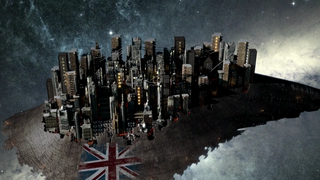
This was, as a lot of people are pointing out, probably the least Moffat-esque script that the man himself has written for the show since 2005. None of his usual timey-wimey paradoxes, relatively-little overtly-comic banter (which isn't to say that it wasn't funny), not a hint of romance, and at no point did an almost-but-not-quite human figure repeat anything even vaguely reminiscent of a catchphrase. In fact, the lurching-monster quotient was surprisingly-low, with the Smilers failing to make as much of an impact as their appearance in earlier trailers might have suggested. It did, however, really hammer home what I think is going to shape up to be the fundamental difference between Russell T. Davies' Who and Steven Moffats – for all the scares in ‘The Empty Child’, ‘Blink’ or ‘Silence In The Library’, his vision of the show is ultimately lighter, more optimistic, and without the nihilism which was often lurking just below the superficial frothiness of Davies' vision for the show.
Just think of the Toclafane, from 'The Sound Of Drums’/’Last Of The Time Lords' - the inevitable future of mankind, to degenerate into a callously-homogenised army of hideously-mutated Steel Balls of Death, who kill, slaughter and maim their own ancestors for the sheer glee of it. And for all the sometimes-justified criticism of Davies’ reset-button endings, that one’s never fixed – that’s now the official Whoniverse End Of Humanity. Never mind shadow-piranhas or creepy statues which jump out and say "Boo" - that's how you do "dark" in a Doctor Who story. In the finest spirit of post-apocalyptic horror being served up to a post-football Saturday evening audience, it's one of the most shockingly-bleak ideas in the show's entire history. Nothing Moffat has ever done is that genuinely dark, and I seriously doubt that it ever will be. His mind simply doesn't work that way. His stories tend to be a lot more complicated than Russell’s, but at the same time, they’re arguably less complex, at least emotionally.
They're also, generally, a lot less freewheeling, more tightly-controlled and elaborately-structured. Which is why ‘The Beast Below’ came as such a delightful surprise (it’s also, I suspect, why it seems to have been a bit of a ‘Marmite’ story within Who fandom at large). Instead of exhaustively wrapping every idea, every loose plot strand up into a neat, intricate package, this was a sprawling mess of a script, packed with more ideas than it really had space to properly explore, and it was all the better for it. Watching the accompanying episode of Doctor Who Confidential, I was delighted to see that Moffat’s explanation for the half-human/half-Smiler creatures amounted, essentially, to “I just thought it was a cool idea”. It didn’t turn out to be intrinsic to the episode’s plot, as has been the case for most of the apparently-incongruous elements of his previous stories. He wanted a cool monster, so he stuck it in there, and trusted his audience to simply accept it because it felt right. That’s pure Doctor Who, and now that Moffat’s shown that he’s willing and able to let his imagination run unfettered when it seems appropriate, I think I’m finally ready to relax, and just enjoy his era on its own merits.
Speaking of merits…Matt Smith IS the Doctor. Brilliantly-so. If I had any reservations after ‘The Eleventh Hour’, it was that a lot of his dialogue, and a few mannerisms, were heavily-reminiscent of David Tennant’s Tenth Doctor – this episode absolutely blew those concerns away. While the character retains that innate essence of Doctor-ness which has been in place for well over forty years, Smith is bringing a lot to the part which is fresh and new. Simultaneously, though, he's cherry-picking elements of older Doctors, particularly Patrick Troughton, which weren’t really present with either Eccleston or Tennant. His freewheeling, unforced eccentricity is infectious, but there’s a lot more to him than just wackiness or mania – there’s an analytical, professorial air which is in sharp contrast to his immediate predecessor.

Very astutely, given Smith’s relative youth, both this episode and ‘The Eleventh Hour’ have included prominent scenes where he gets to interact with children – not only does he have a charming, easy-going chemistry with the young actors, but by placing him in that context, we get to see him from their perspective – not quite an authority figure, perhaps, but still as someone Old, who radiates wisdom and kindness in equal measure. That instinctively colours our impression of the character - it’s a very clever touch on Moffat’s part, and it’s worked magnificently.
Karen Gillan, as new companion Amy Pond, is similarly-excellent – she was split up from the Doctor for quite a bit of this story, which gave Gillan a welcome opportunity to show how the character fares alone. Happily, she more than holds her own. I’m trying hard to steer clear of the adjective “feisty” – not only does it seem to come as standard for all red-headed actresses, but it’s also been applied to every female Doctor Who companion since the ‘60s, and has become terribly-stale as a result. She blatantly is, though, which makes it rather hard to avoid. Independent, intelligent but clearly troubled – partly as a direct consequence of the Doctor’s appearances throughout her life, which gives an interesting twist to their relationship – it’s clear that there are still depths to her character which we’ve barely seen hinted at, and much of the meta-narrative of this season is presumably going to be devoted to the Doctor’s attempts to draw them out. Shades of the Seventh Doctor and Ace, perhaps, but hopefully rather better-written. That should fit well with the Troughton-isms in Smith’s performance.

The story was, like ‘The Eleventh Hour’, distinctly-reminiscent of a number of previous episodes – but where that one drew heavily from Moffat’s own back catalogue, this was a far more haphazard blend of elements from what I like to think of as RTD’s “mad future” stories – ‘The End Of The World’, ‘Gridlock’, and even ‘The Long Game’ were brought to mind, although it remained still very much its own entity. It reached further back, too – most notably to Tom Baker’s ‘The Ark In Space’, whose 29th Century exodus from Earth was directly referenced. There was also a sizeable chunk of Sylvester McCoy in there, with the Doctor effortlessly bringing down a whole corrupt society in a few short hours, just as he did in ‘Paradise Towers’, ‘The Happiness Patrol’, and so many of the Virgin New Adventures novels.
This Doctor may be good with kids and quick to crack a joke (the “escaped fish” gag was inspired), but there’s a steeliness, an unwillingness to compromise, behind that youthful façade, and it’s intriguingly-different from his predecessor’s “no second chances” persona. Quieter, less bombastic, but more intense and possibly more frightening – the moment in the torture chamber/pilot room, where he coldly dismissed Amy without a second thought, was genuinely chilling. We haven’t seen that side of the Doctor since Eccleston unceremoniously dumped hapless would-be companion Adam back on Earth, and that cold brusqueness was even more un-nerving here, directed at a character who we actually like. It’s good that the new Doctor is likeable, but it’s even better that we can’t always be entirely comfortable with him, either.
OK, here’s the gerbil.

I’m trying hard not to get too carried away, but if the show maintains this sort of standard, then not only are we in for a very strong season, but Matt Smith may just shape up into one of my favourite Doctors ever. So far, so very good indeed.
Saturday, March 27, 2010
Day 01: My Favourite Song
...a phrase to inspire terror in the heart of anyone with the slightest fondness for music. One song? How on Earth could anyone possibly be expected to condense the vast expanses of their (doubtless awe-inspiringly broad and eclectic) taste in music into a single song? Surely you jest, good sir - or, indeed, madam, since I acquired this particular challenge from a person of the Female persuasion?
Which is, of course, precisely the sort of ridiculous over-thinking which defines the nerd mindset. Just pick a damn song, and have done with it. Yes, you'd almost certainly come up with something different if you were asked the same question on a different day, or while in a different mood, or with a stronger Moon in the ascendant. But you weren't, you were asked it now. As, indeed, was I. So, with a certain numbing inevitability...
Well, it sort of had to be, really. There are plenty of singers with stronger voices than Chuck Berry, songwriters with more depth and range, and even a few guitarists who could probably outplay him on a good day. There are rock & roll songs which defined the template before 'Johnny B. Goode', and songs which came later and refined it into something more sophisticated, more powerful, and more successful.
But to this day, I don't think any song has ever taken the form to such heights of utter perfection. 'Johnny B. Goode' is - and watch carefully here, as I tiptoe uncertainly out onto the precipice of absurdly-overblown hyperbole - arguably the single greatest work of art produced in the last century. Richer than Joyce's Ulysses, more universal than Eliot's The Waste Land, more evocative than Picasso's Guernica . . . possibly even more spectacular than that amazing wig Elton John wore to his 50th birthday party. If haiku is the true test of a poet's skill - challenging the writer to overcome the incredibly-rigid constraints of a brief, three-line structure - then the 12-bar blues is surely the litmus test for any truly great rock guitarist. An incredibly restrictive formula, with little room for indulgence or showboating, but one with room for potentially-infinite variations on a theme. Chuck Berry spent more time than most exploring what could be done within that formula, and he outdid himself with 'Johnny B. Goode'.
If rock & roll is the artform which defines the 20th century - and I'd argue strongly that it is - then 'Johnny B. Goode' is the song which defines that artform. The iconic riff (lifted note-for-note as it is from Louis Jordan's '(Ain't That) Just Like A Woman', in a splendid demonstration of the truth behind the maxim "talent borrows, genius steals") sums up the exuberance, drive and pulse which lies at the heart of all great rock music more clearly than anything recorded before or since. The deceptively-simple lyrics sketch a story in colourful, broad strokes, providing just the right amount of detail needed to paint a vivid picture, and no more. There isn't a word wasted, not a note played or omitted which isn't absolutely necessary, and at a little over two-and-a-half minutes, it's over almost before you've noticed that it's there. It's been covered more times than almost anything else in the rock & roll canon, but nobody has ever quite matched the timeless perfection of Berry's original. It's the only song of which I could never imagine growing weary*, and it will never, ever die.
There are genres beyond pure rock & roll to which I listen far more frequently, and there are artists to whose work I'm far more devoted than Chuck Berry. But none of them could have existed without his influence, and this is his crowning glory.
A masterpiece.
*A hypothesis I tested to somewhere approaching breaking-point a few months ago, when in response to a slightly-silly challenge I'd made to myself, I listened to it on repeat, without pause or variation, for a little over three consecutive hours. Not something I'd rush into doing again, perhaps, but at no point did I feel any inclination to turn the damn thing off, and it's not impacted my ability to enjoy the song in the slightest. It has, however, imprinted every last note into my head so firmly that I could, and occasionally do, listen to it in my sleep.
Which is, of course, precisely the sort of ridiculous over-thinking which defines the nerd mindset. Just pick a damn song, and have done with it. Yes, you'd almost certainly come up with something different if you were asked the same question on a different day, or while in a different mood, or with a stronger Moon in the ascendant. But you weren't, you were asked it now. As, indeed, was I. So, with a certain numbing inevitability...
Well, it sort of had to be, really. There are plenty of singers with stronger voices than Chuck Berry, songwriters with more depth and range, and even a few guitarists who could probably outplay him on a good day. There are rock & roll songs which defined the template before 'Johnny B. Goode', and songs which came later and refined it into something more sophisticated, more powerful, and more successful.
But to this day, I don't think any song has ever taken the form to such heights of utter perfection. 'Johnny B. Goode' is - and watch carefully here, as I tiptoe uncertainly out onto the precipice of absurdly-overblown hyperbole - arguably the single greatest work of art produced in the last century. Richer than Joyce's Ulysses, more universal than Eliot's The Waste Land, more evocative than Picasso's Guernica . . . possibly even more spectacular than that amazing wig Elton John wore to his 50th birthday party. If haiku is the true test of a poet's skill - challenging the writer to overcome the incredibly-rigid constraints of a brief, three-line structure - then the 12-bar blues is surely the litmus test for any truly great rock guitarist. An incredibly restrictive formula, with little room for indulgence or showboating, but one with room for potentially-infinite variations on a theme. Chuck Berry spent more time than most exploring what could be done within that formula, and he outdid himself with 'Johnny B. Goode'.
If rock & roll is the artform which defines the 20th century - and I'd argue strongly that it is - then 'Johnny B. Goode' is the song which defines that artform. The iconic riff (lifted note-for-note as it is from Louis Jordan's '(Ain't That) Just Like A Woman', in a splendid demonstration of the truth behind the maxim "talent borrows, genius steals") sums up the exuberance, drive and pulse which lies at the heart of all great rock music more clearly than anything recorded before or since. The deceptively-simple lyrics sketch a story in colourful, broad strokes, providing just the right amount of detail needed to paint a vivid picture, and no more. There isn't a word wasted, not a note played or omitted which isn't absolutely necessary, and at a little over two-and-a-half minutes, it's over almost before you've noticed that it's there. It's been covered more times than almost anything else in the rock & roll canon, but nobody has ever quite matched the timeless perfection of Berry's original. It's the only song of which I could never imagine growing weary*, and it will never, ever die.
There are genres beyond pure rock & roll to which I listen far more frequently, and there are artists to whose work I'm far more devoted than Chuck Berry. But none of them could have existed without his influence, and this is his crowning glory.
A masterpiece.
*A hypothesis I tested to somewhere approaching breaking-point a few months ago, when in response to a slightly-silly challenge I'd made to myself, I listened to it on repeat, without pause or variation, for a little over three consecutive hours. Not something I'd rush into doing again, perhaps, but at no point did I feel any inclination to turn the damn thing off, and it's not impacted my ability to enjoy the song in the slightest. It has, however, imprinted every last note into my head so firmly that I could, and occasionally do, listen to it in my sleep.
Subscribe to:
Posts (Atom)


